Health Systems Built for Treatment, Not Wellbeing
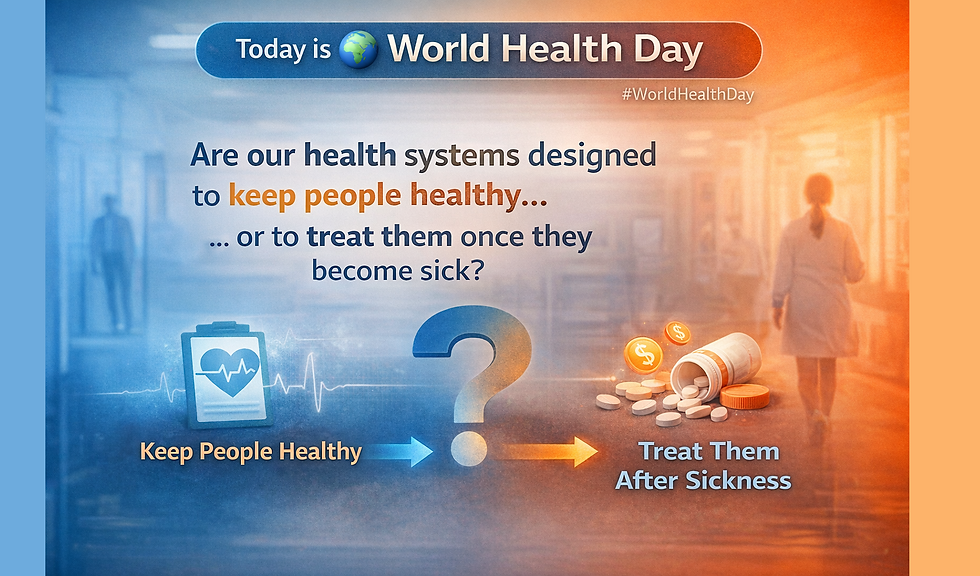
Aligned with the occasion of World Health Day, it is worth asking a difficult question:
Are our health systems really designed to create health — or are they still primarily designed to react to illness?
Modern healthcare has become extraordinarily advanced in diagnosing disease, treating acute conditions, performing surgery, and managing complex episodes of care. But that does not automatically mean it is equally strong at maintaining health, preventing deterioration, or helping people stay well in the first place.
That is the gap.
Across most systems, the shift from sick care to health and wellbeing care remains incomplete. Even where value-based care is being discussed or piloted, the deeper transformation is still underway: a change in philosophy, incentives, regulation, performance metrics, and delivery models. As long as the system mainly activates when a person becomes unwell, it will continue to treat sickness more naturally than it supports wellbeing. (PwC)
This does not mean hospitals, surgeries, emergency care, or specialist treatment become less important. Quite the opposite. There will always be urgent cases, complex conditions, high-risk chronic diseases, surgeries, and moments when people truly need facility-based care. But if systems are serious about sustainability, they cannot remain built mainly around what happens after the problem has escalated.
Why the old model is no longer enough
The case for change is no longer philosophical; it is economic and epidemiological.
According to WHO, non-communicable diseases account for 74% of global deaths, and in 2021 they caused at least 43 million deaths worldwide. (WHO) In the Eastern Mediterranean Region, WHO says NCDs claim 2.8 million lives annually. (WHO-EMRO)
The GCC is directly exposed to this burden. Alpen Capital projects GCC healthcare expenditure to rise from US$109.1 billion in 2024 to US$159 billion in 2029, with high NCD prevalence, rising treatment costs, medical inflation, and insurance expansion all contributing to the growth. (Alpen Capital) Diabetes alone illustrates the pressure: the International Diabetes Federation reports that 85 million adults in the MENA region are living with diabetes, with 32 million undiagnosed, and in the UAE adult diabetes prevalence is 20.7%. (IDF)
And yet health systems still devote relatively little spending to prevention. OECD analysis found that countries allocated on average 2.8% of total health expenditure to preventive care, with most clustered between 2% and 4%. (OECD) If spending patterns show what systems truly prioritize, then many systems are still built much more for treatment than for wellbeing.
The unfinished shift from treatment to wellbeing
This is why the shift is not only clinical — it is systemic.
A wellbeing-oriented system would:
reward earlier engagement rather than late-stage intervention,
support continuity rather than episodic transactions,
use data from daily life, not only from clinical visits,
measure success not only by procedures and admissions, but also by avoided deterioration, better risk control, stronger adherence, and healthier populations.
That is where digital and connected healthcare become essential. WHO and ITU stated in 2024 that an additional investment of just US$0.24 per patient per year in digital health interventions such as telemedicine, messaging, and chatbots could help save more than 2 million lives from NCDs over the next decade and avert around 7 million acute events and hospitalizations. (WHO)
This is not a small insight. It suggests that the economics of prevention are often not blocked by the cost of the tools themselves, but by the structure of incentives around them.
Why providers are the hardest stakeholder to convince
If patients benefit, payors can save, policymakers can improve public health, and innovators can scale solutions, why is adoption still slow?
Because for many providers, especially in insurance-driven systems, preventive and connected care can feel commercially ambiguous.
That concern is not irrational. In many traditional payment environments, revenue is more visible and immediate when a patient attends, is tested, is treated, is admitted, or undergoes a procedure. Prevention can therefore look, at first glance, like it reduces traffic - and revenue. If patients are managed earlier, if chronic disease deterioration is delayed, if avoidable visits decline, then some providers worry that part of the activity they currently depend on will soften.
That fear is not unique to the GCC. PwC notes that in systems still driven by budget or fee-for-service, clinicians and providers often fear value-based models and cites survey evidence that 61% believed value-based healthcare would negatively affect their practice while 63% feared a hit to earnings from the shift away from fee-for-service. (PwC)
So, the provider hesitation is understandable. But it is also incomplete, because it sees preventive care only as a reduction in existing activity — not as an opportunity to redesign value.
How providers can turn the “loss” into a gain
This is the real strategic question.
If providers remain dependent only on episodic, facility-based revenue, then yes — prevention can look like cannibalization. But if they broaden the model from “transactions when people are sick” to “relationships that help people stay well,” then prevention becomes a platform for new revenue, stronger loyalty, lower waste, and better differentiation.
That shift can happen in several ways.
1. Subscription-based wellbeing and chronic care programs
Providers can offer recurring membership models for:
diabetes support,
hypertension and cardiovascular follow-up,
women’s health and risky pregnancy monitoring,
post-discharge recovery programs,
mental health support,
preventive check-up and coaching bundles
This converts some lost episodic utilization into predictable recurring revenue while strengthening retention and improving outcomes.
2. Virtual-first preventive care pathways
Instead of waiting for hospital visits, providers can design digital pathways that combine:
remote monitoring,
nurse/coach outreach,
clinician escalation when needed,
education,
medication adherence support,
lifestyle and risk coaching.
That lets providers remain part of the patient journey continuously, not only when symptoms become serious.
3. Employer-sponsored and payer-linked programs
Providers do not have to sell only to individual patients. They can package preventive and connected care for:
employers,
insurers,
government programs,
disease-management initiatives.
This makes prevention a contracted service line, not a voluntary side offering.
4. Shared-savings and outcome-linked models
This is where provider economics can evolve most powerfully. PwC’s value-based healthcare framework describes funding models such as shared savings, outcomes-based funding, and performance incentive funding — mechanisms that allow providers to participate financially in the value they help create. (PwC)
In other words, the provider should not only be paid for treating deterioration; it should also be rewarded for preventing avoidable deterioration.
5. A stronger patient relationship
Even where direct preventive revenue is modest, connected care can improve:
patient trust,
retention,
continuity,
referral behavior,
brand differentiation.
A provider that helps people stay healthier can become more valuable, not less.
Why the other stakeholders are easier to align
Policy makers
For governments and regulators, the case is relatively straightforward. Healthier communities, lower long-term burden from NCDs, and stronger alignment with national digital transformation agendas all support the shift. WHO explicitly argues that digital health should be integrated more deeply into mainstream health systems to address the preventable burden of NCDs. (WHO)
Payors
Insurers and payors tend to be more naturally aligned with prevention because they carry the cost of claims. Better chronic disease management, earlier detection, and fewer acute escalations can reduce the total cost of care. That does not mean every payor will immediately move — churn, annual contracting cycles, and fragmented incentives remain real issues — but the economic logic is there.
Patients
For patients, the value proposition is even clearer: fewer avoidable hospital visits, earlier warnings, better daily support, more convenience, and a better chance of maintaining health rather than reacting to illness.
Pioneers and solution providers
The opportunity is obvious here. If the system rewards wellbeing more seriously, the market opens for connected platforms, prevention tools, chronic disease solutions, AI-supported care, and population health technologies.
So, what needs to change?
If systems are serious about shifting from sickness to wellbeing, then prevention cannot remain a side conversation. It has to be visible in:
policy,
reimbursement,
provider incentives,
performance metrics,
care pathway design,
and digital infrastructure.
Hospitals should not be evaluated only on admissions, procedures, throughput, or occupancy. Over time, they also need to be measured on:
preventable deterioration avoided,
chronic disease control,
readmission reduction,
engagement in connected care,
continuity across the patient journey,
and real population-level improvement.
That is where the philosophy changes. The question stops being, “How efficiently do we treat illness?” and becomes, “How effectively do we preserve health, delay deterioration, and improve life over time?”
Final thoughts
Health systems will always need to treat illness. That is not changing. But if they are built only for treatment, they will always arrive too late in too many cases. The next step in healthcare is not to replace treatment with wellbeing. It is to stop treating them as separate worlds.
Because the most sustainable health system is not the one that becomes better only when people are sick. It is the one that works every day to help them stay well.


Comments